At Black Hat USA 2026, BT6 researchers demonstrated how inputs delivered through a robot dog’s camera and microphone could manipulate its AI and trigger physical movement.
By VMGTS Team ·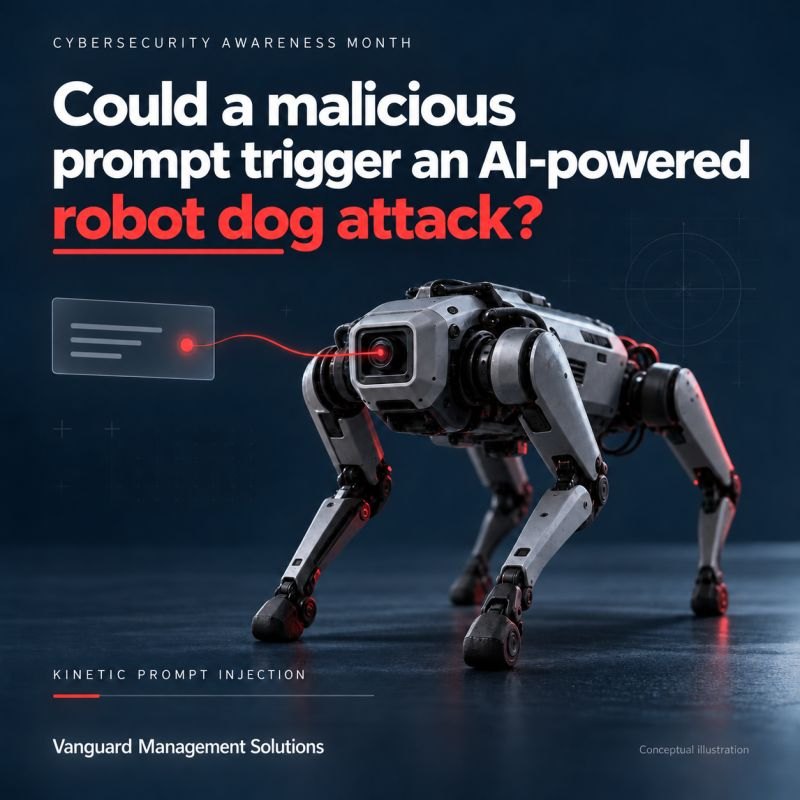
Could a malicious prompt cause an AI-powered robot to take unsafe physical actions?
At Black Hat USA 2026, BT6 researchers demonstrated how inputs delivered through a robot dog’s camera and microphone could manipulate its AI and trigger physical movement. Their presentation, “Kinetic Prompt Injection: Agent Compromise With a Physical Blast Radius,” illustrates how AI compromise can have consequences beyond a screen. --> https://lnkd.in/gSe-hgi8
Prompt injection occurs when an AI system treats untrusted content as instructions. The security concern becomes more consequential when that system has permission to act.
For organizations adopting AI, three questions deserve attention:
- Trust boundaries: Can content the system reads, sees, or hears influence privileged decisions?
- Least privilege: Does the AI have only the capabilities and permissions required for its task?
- Independent enforcement: What prevents an unsafe action even if the model requests it?
The researcher’s accompanying analysis highlights a critical principle: physical safety limits must remain outside the AI’s authority to weaken or disable. Model guardrails can help reduce risk. Independent controls must contain the consequences when those guardrails fail. (https://lnkd.in/gwiFrKWP)
This Cybersecurity Awareness Month, AI adoption deserves a place in conversations about operational resilience, security ownership, and safety.
If your AI were manipulated today, what could it do and which controls would still stop it?
#CybersecurityAwarenessMonth #AISecurity #PromptInjection #Cybersecurity #VMGTS